Sunday, 4 March 2012

Marathon for Palestine


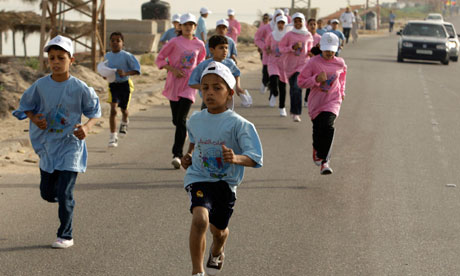
Braving bad weather conditions, including cold weather and strong winds, thousands of children and adults took part in a marathon which covered the whole length of the Palestinian territory[1]. This marathon, the second of its kind, is organized by the United Nations Agency for Palestinian Refugees (UNRWA) in order to raise funds for summer camps and to raise awareness for the situation in Palestine (specifically the Gaza-Strip which is blockaded by Israel causing major humanitarian concerns)[2].


However, this event was not simply about politics. As the UNRWA Deputy Director states: "The marathon sends two messages; the first is that Gaza children are seeking to enjoy a normal life equal to other children in the world and the second that UNRWA is in real need from Arab and international countries to keep providing services to the Strip's people[3]." 

‘Fun’ is an aspect of life that many children in Gaza are missing out on due to the unimaginable humanitarian conditions that have arisen due to the Israel’s blockade. ‘Normal’ is another aspect of life that Palestinian children have been unable to experience, especially since the Gaza-War where hundreds of innocent children and women were killed due to Israeli airstrikes.

Still, I am not going to argue for or against Israel in this post (let us not forget that Hamas and other extremist organizations in Palestine have carried out horrific attacks on Israel). Instead, I believe that events such as the marathon are a great way to promote to the world that Palestinians are in fact after a normal, equal life. 

Although Hamas is widely recognized as an extremist-Islamist group, they allowed both female and male runners to participate in this marathon (contrary to their views), which raises money for co-ed summer camps. Additionally, this seeks to show that Palestinians are more united than they are reported to be. Regardless of recent agreements between Hamas and Fatah, the media continues to portray Palestine as internally ‘divided.’ Yet, this marathon proves that Palestinians, whether members of Hamas or Fatah, all believe in a better future. 


Gemma Connell, a runner from last year’s marathon, explained: 

"I ran through refugee camps, past farmers and street cleaners. They all clapped and shouted: 'Salam Alaikum'. The variety of scenery and the welcome was incredible and there was the unspeakable beauty of the Mediterranean, which gave me the energy to keep going[4]."  

Since political attempts to recognize the dire conditions in the Palestinian territories, and to recognize the Palestinian states have generally failed (due to the stance of the USA), I reckon this was a very successful event, and that more activities, such as this marathon, should be held in the Palestinian territories in order to portray to the world a peaceful, united, community that is simply longing for equality, justice, and peace. These activities highlight the dire conditions that many Palestinians face:  not only do they encourage Palestinians to be involved, have fun, and forget about their differences, but they also allow the world to view Palestinians as human beings that are being deprived of basic human rights.

What are your views on this event? 


[1] http://www.bbc.co.uk/news/world-middle-east-17225400
[2] http://www.guardian.co.uk/world/2011/may/05/gaza-stages-first-marathon
[3] http://www.haaretz.com/news/middle-east/gaza-children-run-marathon-to-raise-funds-for-un-summer-camps-1.415913
[4] http://www.guardian.co.uk/world/2011/may/05/gaza-stages-first-marathon

The Question of Humanitarian Intervention


Whether powerful states have a responsibility to intervene in humanitarian crises has been regularly debated. For the purpose of this post, as defined by Holzgrefe, humanitarian intervention is the use of military power to end widespread violations of human rights[1], and is best carried out by powerful states that are able to exert their military, political, and economic influence either regionally or globally. In a responsibility to intervene exists, several arguments will be examined: the presence of the responsibility to intervene irrespective of national self-interest; whether principles of sovereignty alleviate this responsibility; and the importance of consensus regarding human rights.  By examining these aspects, one will be able to conclude the extent to which powerful states have a responsibility to intervene.

Realists have often argued that powerful states do not have the responsibility to intervene in humanitarian crises, unless it would benefit their national self-interest. Nicholas Wheeler writes that the pursuit of national self-interest results in the selective application of human rights principles[2]. A regularly used example is the Rwandan genocide: no powerful states intervened because no economic, political, or strategic interests existed[3]. However, constructivists stress that the emergence of a humanitarian intervention norm could cause states to consistently intervene in humanitarian crises, regardless of their national self-interest: this norm would imply that it is expected of powerful states to intervene[4]. It has been claimed that the recent intervention in Libya is a ‘watershed’ for this norm, where states intervened in order to stop the systematic killing of civilians by the Gadhafi government[5]. At the same time, no intervention has occurred in Syria, where the government is committing similar atrocities. However, Gareth Evans writes that military interventions have in many cases not occurred due to the lack of reasonable prospects that such intervention would not cause further harm[6]. It is important to remember that although military intervention has been highly selective, other forms of intervention (such as economic sanctions and diplomatic discourse) have been consistently implemented by powerful states, regardless of their national self-interest.  For example, many powerful states adopted economic sanctions against the Apartheid government of South Africa, regardless of the fact that these sanctions worked against their economic interests. It can therefore be established that there has been a developing tendency where states do have the responsibility to intervene, regardless of their national self-interest.

It has often been argued that powerful states do not have the responsibility to intervene in humanitarian crises due to the principles of sovereignty. Sovereignty, the supreme authority within a given territory[7], has been central to international society since the Peace of Westphalia[8], and has often been used as a shield against humanitarian intervention.  According to pluralist theory, humanitarian intervention would “damage international stability[9]” as it sets precedence for further intervention in a state’s internal affairs. However, it has been argued that there has been an emerging norm, where extreme violations of human rights provide the international community with a moral obligation to intervene. Thomas Farer argues that sovereignty is not an “absolute right[10]” and should be subject to “minimum standards of decency[11].” This idea that sovereignty entails a responsibility towards human rights forms the principal framework of a doctrine entitled “The Responsibility to Protect (R2P)” by the International Commission on Intervention and State Sovereignty (ICISS).  R2P states that if a state pursues extreme violence against its citizens, then it is the responsibility of capable international actors to intervene[12]. Michael Doyle writes that the recent intervention in Libya on the principles of R2P portrays a rise in the norm of humanitarian intervention in the cases of extreme violations of human rights, despite national sovereignty[13].  Therefore, it is clear “the extent to which a state enjoys the full benefits of sovereignty is a condition of its behavior[14]:” if that behavior violates human rights, then it is the responsibility of powerful states to intervene.

Pluralists have often claimed that humanitarian intervention is not justified, because the international community has been unable to reach consensus regarding global principles of human rights. This is evidenced by numerous situations where powerful states have been inconsistent and ineffective in dealing with humanitarian crises due to the failure to reach consensus[15].On the other hand, Amy Dowell contends that humanitarian intervention is justified, irrespective of sufficient consensus, because there is established “global standards of justice and human rights that necessitate[16]” intervention by international actors in humanitarian crises. These global standards have been recognized in numerous international treaties, including the Universal Declaration of Human Rights.  Additionally, recent arguments have shown that there is an emerging international norm which encourages humanitarian intervention even if states are unable to reach consensus. Yet, pluralists claim that humanitarian intervention that overlooks consensus could damage international order[17]. Conversely, the ICISS states that the damage to international order is greater “if human beings are slaughtered while the UN Security Council stands by[18].” What this seeks to demonstrate is that the lack of UNSC consensus should not relieve the responsibility of powerful states to intervene in humanitarian crises. An example of this can be seen where NATO (without UN approval) intervened in Kosovo. Still, the ICISS warns that the UN should not be undermined as it is central to the stability of international law and ideals[19]. Overall, it is evident that humanitarian intervention is limited by consensus: this makes it the responsibility of powerful states, specifically members of the UNSC, “to find common ground …and act in the defense of our common humanity[20].”

It is evident that there is an emerging international norm that powerful states have the responsibility to intervene in humanitarian crises. Although realists have argued that national self-interest is the central for humanitarian intervention, it is clear that there is an emerging norm (as evidenced by the recent Libyan intervention) where it is the responsibility of powerful states to intervene, regardless of national self-interest. Moreover the pluralist contention that humanitarian intervention violates sovereignty and could thus damage international stability was disregarded due to an emergence of a norm (as seen by the R2P) which establishes that powerful states do have the responsibility to intervene if a state is committing mass-abuse of human rights. Finally, the lack of international consensus regarding numerous crises where powerful states have failed to intervene supports the pluralist contention that powerful states should not intervene; but this does not alleviate the responsibility of powerful states to reach a consensus and act against humanitarian crises. Overall, to a great extent, powerful states do have a responsibility to intervene in humanitarian crises.


[1] J. L. Holzgrefe and Robert O. Keohane, "Part 1:The Context For Humanitarian Intervention," in Humanitarian Intervention: Ethical, Legal, and Political Dilemmas (Cambridge: Cambridge University Press, 2003), pg. 18.
[2] Nicholas J. Wheeler, Saving Strangers: Humanitarian Intervention in International Society (Oxford: Oxford University Press, 2000), pg. 209.
[3] Amy Dowell, "The International Community and Intervention in Cases of Genocide,"University of Leeds Student Journal: pg. 10, accessed November 5, 2011, http://www.polis.leeds.ac.uk/assets/files/students/student-journal/amy-dowell-summer-09.pdf.
[4] Ibid, p.15
[5] Jayshree Bajoria, "The Dilemma of Humanitarian Intervention," Council on Foreign Relations, March 24, 2011, accessed November 4, 2011, http://www.cfr.org/human-rights/dilemma-humanitarian-intervention/p16524.
[6] Gareth Evans and Mohamed Sahnoun, The Responsibility to Protect: Report of the International Commission on Intervention and State Sovereignty (Ottawa, Ont.: International Development Research Centre, 2001), pg. XII.
[7] Alain De Benoist, "What Is Sovereignty?," , accessed November 5, 2011, http://www.alaindebenoist.com/pdf/what_is_sovereignty.pdf.
[8] Thomas G. Weiss, "The Sunset of Humanitarian Intervention? The Responsibility to Protect in a Unipolar Era," Security Dialogue 35, no. 2 (2004): pg. 138, accessed November 4, 2011, http://ics.leeds.ac.uk/papers/pmt/exhibits/1898/weiss.pdf.
[9] Amy Dowell, "The International Community and Intervention in Cases of Genocide,"University of Leeds Student Journal: pg. 6, accessed November 5, 2011, http://www.polis.leeds.ac.uk/assets/files/students/student-journal/amy-dowell-summer-09.pdf.
[10] T. J. Farer, "Roundtable: Humanitarian Intervention After 9/11," International Relations 19, no. 2 (June 01, 2005): pg. 212, doi:10.1177/0047117805052814.
[11] Ibid, p.213
[12] Gareth Evans and Mohamed Sahnoun, The Responsibility to Protect: Report of the International Commission on Intervention and State Sovereignty (Ottawa, Ont.: International Development Research Centre, 2001), pg. XII.
[13] Michael W. Doyle, "The Folly of Protection," Foreign Affairs, March 20, 2011, accessed November 5, 2011, http://www.foreignaffairs.com/ARTICLES/67666/michael-w-doyle/the-folly-of-protection?page=show.
[14] Lee Feinstein, Darfur and Beyond: What Is Needed to Prevent Mass Atrocities(New York, NY.: Council on Foreign Relations, 2007), pg. 5.
[15] High-level Panel on Threats, Challenges and Chang, A More Secure World: Our Shared Responsibility, report (New York, NY.: United Nations, 2004), pg. 4.
[16] Amy Dowell, "The International Community and Intervention in Cases of Genocide,"University of Leeds Student Journal: 6, accessed November 5, 2011, http://www.polis.leeds.ac.uk/assets/files/students/student-journal/amy-dowell-summer-09.pdf.
[17] Ibid, p.7
[18] Gareth Evans and Mohamed Sahnoun, The Responsibility to Protect: Report of the International Commission on Intervention and State Sovereignty (Ottawa, Ont.: International Development Research Centre, 2001), pg. 55.
[19] David Chandler, "The Responsibility to Protect? Imposing the ‘Liberal Peace’,"Peace Operations and Global Order: pg. 67, accessed November 6, 2011, http://www.iilj.org/courses/documents/DavidChandlerTheResponsibilitytoProtect.ImposingtheLiberalPeace.pdf.
[20] Kofi A. Annan, "Two Concepts of Sovereignty," The United Nations, September 18, 1999, accessed November 4, 2011, http://www.un.org/News/ossg/sg/stories/articleFull.asp?TID=33&Type=Article.

The Democratic Peace Theory - A Myth?


According to the writings of Michael Doyle, the liberal democratic peace theory is an idea that liberal democratic states are much more likely to have peace with each other, and less likely to go to war[1]. In order to analyze the extent to which this is true, several aspects of liberal democracies must be examined: the public’s role in democratic states; the role of economic factors including interdependence; and the nature of powerful democratic states. By examining these aspects, one will be able to explore what the liberal democratic peace theory is, and whether its’ central premise is accurate.

Philosopher Immanuel Kant argues that ‘perpetual’ peace is most likely to be achieved under a republican constitution, because it is the public that experiences the hardships and immense consequences of war; thus they would most likely vote against war[2]. On the other hand, Kant argues that in non-republican constitutions “a declaration of war is the easiest thing in the world to decide upon,[3]” because the ruler is not the one that is required to make sacrifices. Modern theorists have applied this theory to democracy. One of the main definitions of democracy is ‘people’s rule’. This definition is applied in Abraham Lincoln’s Gettysburg Address, where he states “government: of the people, by the people, for the people.[4]” However, there has been much criticism of the democratic peace theory, specifically regarding the public’s role. Prior to the Iraq War, 54% of Americans favoured a U.S invasion of Iraq[5]. On the surface, it may seem like this decision was ‘democratic’. Yet, historian Weart contends that certain characteristics of democratic politicians are ignored: “lying, manipulation, and ruthlessness.[6]” The U.S Government manipulated public opinion by falsely accusing Iraq of having weapons of mass destruction; thus undermining the public’s role. Since liberal democracies have representative governments, it is possible that certain decisions taken by governments are against public opinion. For example, the Russian Provisional Government was determined to continue its’ participation in WWI, contrary to popular sentiment[7]. Thus, isn’t it possible to compare an elected government to a ruler in a non-republican constitution? Still, it is difficult to ignore the impact that public opinion can have on decision making, and the possibility that public opinion in democratic states has managed to maintain peace.

It is often argued by theorists, such as Havard Hegre, that democracy does reduce the likelihood of war, only if there is a developed economy[8]. In an assessment for the World Bank, Hegre concludes that economic development only reduces the likelihood of war in democratic countries[9]. This may challenge the democratic peace theory as it is not clear whether democracy is a consequence of a stable economy, or a cause of it.  Also, Michael Mousseau determines that if a democratic country has low-levels of development, then the risk of war is not reduced[10].  Mousseau’s argument thus invalidates the democratic peace theory because the theory does not distinguish between the different economic conditions of democratic countries. Furthermore, Erich Weede contends that economic interdependence and trade, not democracy, lead to a reduced risk of war[11]. This is because such interdependence leads to economic interest groups being formed, and governments would not want to disrupt such interests[12]. Many liberals, such as Richard Rosecrance, argue that WWII would not have occurred had all the states been democratic, because economic interdependence is more likely to be present between democracies[13]. However, realists tend to argue that interdependence may increase the risk of war because of the changing expectations of future trade. Additionally, realists believe that countries that are dependent on others for vital goods have a greater incentive to go to war in order to maintain access to these goods[14]. Nevertheless, such arguments have been disputed, because realists tend to ignore the benefits of interdependence. Therefore, it is clear that democracy and economic factors play a great role in maintaining peace; however it is debateable whether or not economic interdependence is a cause of democracy.

Although democracies rarely enter into war with each other, there have been many cases where they have entered into war with non-democratic states. This challenges the idea that democracies tend to be more peaceful than non-democracies. Professor Joanne Gowa contends that “major powers are much more likely than are other states to become involved in armed disputes, including war.[15]” Since the end of WWII, there have been 27 wars involving powerful liberal democratic states: the USA, UK, France, India, and Israel. Therefore, it would be difficult to disregard Gowa’s contention. Furthermore, the acquirement of nuclear weapons is seen as the greatest threat to world peace. There are only nine states that have nuclear weapons: seven of which are democratic states[16]. Politician Gareth Evans states that “so long as any nuclear weapons remain…they are bound one day to be used[17].” Accordingly, the nuclear weapons developed by these democratic states undermine the whole democratic peace theory. Additionally, democratic states have commonly entered into wars with non-democratic states. For example, the Football War between El Salvador and Honduras occurred after violent clashes between fans during the 1970 FIFA World Cup[18]; interestingly, the war was initiated by the democratic state of El Salvador[19]. Although several theorists, such as R.J. Rummel, claim that democracy promotes non-violence[20], they tend to reclassify certain conflicts as exceptions, or claim that the conflicts did not occur between ‘real’ democracies[21]. However, the democratic peace theory does not state the definition of democracy; consequently, such reclassification is often criticized. The extent to which democracies are less likely to enter into war is therefore questionable, especially since several conflicts have been labelled as exceptions.

In conclusion, it would be difficult to wholly agree with the liberal democratic peace theory. At the same time, it would be erroneous to completely dismiss the theory. Kant believed that people are likely to vote against war as they are the ones that experience its’ hardships. However, the public opinion may be manipulated; thus undermining the public’s role in liberal democracies. Moreover, liberals often argue that economic interdependence, which leads to a reduced risk of war, is a result of democracy. However, the reduced risk of war does not occur in democracies with low economic development. Finally, there have been several conflicts between democracies and non-democracies, which liberals tend to ignore as exceptions. Realists claim that major powers, the majority of which are democratic, are more likely to enter into war than non-major powers. Overall, the extent to which democracies are less likely to enter into war is highly questionable; consequently, it is difficult to agree with the liberal democratic peace theory.


[1] Michael W. Doyle, "Philosophy & Public Affairs," Kant, Liberal Legacies, and Foreign Affairs 12, no. 3 (1983): 205.
[2] Immanuel Kant, "Perpetual Peace: A Philosophical Sketch" (thesis, 1795), Section II, accessed August 25, 2011, http://www.mtholyoke.edu/acad/intrel/kant/kant1.htm.
[3] Ibid.
[4] Abraham Lincoln, "Abraham Lincoln: The Gettysburg Address," InfoUSA: U.S. Department of State, section goes here, accessed August 25, 2011, http://infousa.state.gov/government/overview/gettysburg.html.
[5] Richard Benedetto, "Poll: Most Back War, but Want U.N. Support," USA Today, March 17, 2003, section goes here, accessed August 26, 2011, http://www.usatoday.com/news/world/iraq/2003-03-16-poll-iraq_x.htm.
[6] Spencer R. Weart, Never at War: Why Democracies Will Not Fight One Another (New Haven: Yale University Press, 1998), 84..
[7] Norman Lowe, "Russia and the Revolutions," in Mastering Modern World History, 4th ed. (Houndmills, Basingstoke, Hampshire: Palgrave Macmillan, 2005), 345.
[8] Håvard Hegre, Disentangling Democracy and Development as Determinants of Armed Conflict, thesis, The World Bank, 2003 (Oslo: Peace Research Institute Oslo), 3.
[9] Håvard Hegre, Disentangling Democracy and Development as Determinants of Armed Conflict, thesis, The World Bank, 2003 (Oslo: Peace Research Institute Oslo), 35-36.
[10] Michael Mousseau, Comparing New Theory with Prior Beliefs: Market Civilization and the Democratic Peace, thesis, Peace Science Society (International), 2003 (Istanbul: Koç University, 2003), 8-9.
[11] Erich Weede, The Diffusion of Prosperity and Peace by Globalization 9, no. 2 (2004): 172, accessed August 27, 2011, http://www.independent.org/pdf/tir/tir_09_2_1_weede.pdf.
[12] Erich Weede, The Diffusion of Prosperity and Peace by Globalization 9, no. 2 (2004): 170, accessed August 27, 2011, http://www.independent.org/pdf/tir/tir_09_2_1_weede.pdf.
[13] Dale C. Copeland, "Economic Interdependence and War: A Theory of Trade Expectations," International Security 20, no. 4 (1996), accessed August 27, 2011, http://www.jstor.org/pss/2539041.
[14] Ibid.
[15] Joanne S. Gowa, "Peace," in Ballots and Bullets: the Exclusive Democratic Peace (Princeton: Princeton University Press, 2000), 35.
[16] "List of States with Nuclear Weapons," Wikipedia, Statistics, accessed August 25, 2011, http://en.wikipedia.org/wiki/List_of_states_with_nuclear_weapons.
[17] Gareth Evans, "Nuclear Weapons As A Threat To Global Peace" (speech, UNI Global Union 3rd World Conference, Nagasaki, November 11, 2010), November 9, 2010, accessed August 26, 2011, http://www.gevans.org/speeches/speech430.html.
[18] "Soccer War 1969," OnWar.com - Wars, Military History, International Relations, section goes here, accessed August 26, 2011, http://www.onwar.com/aced/data/sierra/soccer1969.htm.
[19] Ibid.
[20] R. J. Rummel, "Why Does Power Kill?," in Power Kills: Democracy as a Method of Nonviolence (New Brunswick: Transaction Publishers, 1997), 241.
[21] Joanne S. Gowa, "Peace," in Ballots and Bullets: the Exclusive Democratic Peace (Princeton: Princeton University Press, 2000), 52.